
Raster Grid Vacuum Table Setup Instructions
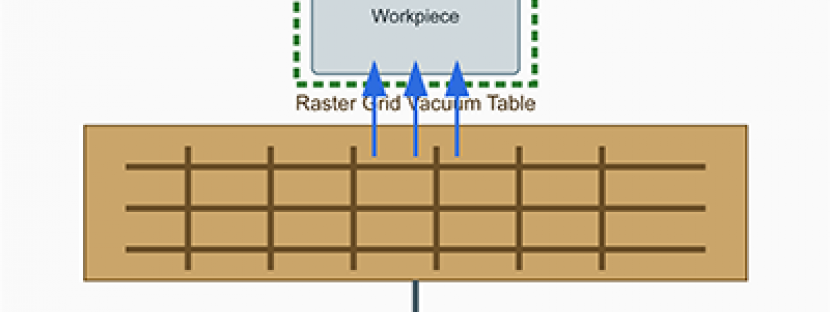
Raster grid vacuum tables use machined channels to distribute vacuum beneath the workpiece. To achieve effective clamping, the supplied rubber sealing cord must be positioned around the part to create a closed vacuum zone.
Correct sealing is essential. Any open channel, unused manifold port or leaking connection will reduce vacuum performance and may prevent secure clamping.
1. Connect the table to the manifold
Connect the vacuum table ports to the corresponding ports on the manifold. This allows vacuum to be distributed correctly across the table.
Each required table port should be linked to a manifold port using suitable vacuum hose and airtight fittings.
2. Connect the vacuum source
The large hose barb on the manifold is the main connection point for the vacuum source.
Connect the vacuum pump, Venturi or other external vacuum generator to this hose barb. If required, use a suitable reducer or adapter to match the fitting size.
3. Position the rubber sealing cord
Place the supplied rubber sealing cord into the raster grid channels around the workpiece.
- create a closed loop around the part
- keep the cord close to the workpiece edge
- ensure the cord sits neatly inside the channels
How the sealing cord works
The sealing cord creates a closed vacuum zone around the workpiece. When the vacuum source is activated, the air is removed from inside this sealed area and atmospheric pressure pushes the workpiece firmly onto the table.
Without the sealing cord, vacuum will spread through open channels and performance will drop significantly.
Important: all unused manifold ports must be sealed
Any manifold port that is not in use must be closed.
This can be done either by:
- connecting it to the vacuum table, or
- closing it with a suitable plug
The complete system must be airtight. Any open port, leaking hose, poorly fitted plug or unsealed channel will reduce vacuum pressure and may prevent secure clamping.
Installation Checklist
- connect all required table ports to the manifold
- connect the large hose barb to the vacuum source
- use a reducer if required for the Venturi or pump connection
- seal all unused manifold ports
- place the sealing cord neatly around the workpiece
- ensure all hoses and fittings are airtight
Tips for Best Performance
- keep the sealing cord as close to the workpiece as practical
- ensure the workpiece surface is flat and suitable for sealing
- avoid gaps, twists or overlaps in the sealing cord
- check that all unused channels outside the sealed area do not affect the vacuum zone
- confirm the vacuum source is suitable for the application and table size
Summary
Raster grid vacuum tables use machined channels to distribute vacuum, while the supplied rubber sealing cord defines the active clamping area around the workpiece.
For correct operation, the table must be connected to the manifold, the manifold must be connected to the vacuum source, all unused manifold ports must be sealed, and the sealing cord must form a complete airtight loop around the part.
Hole Grid vs Raster Grid Vacuum Tables – Full Comparison Guide
Read our guide: Which vacuum pump should I use?